Faculty Of Mechanical Engineering

Labs & Facilities

Undergraduate | Graduate |  Faculty Profiles |  Labs

The laboratories at the Faculty of Mechanical Engineering cater the needs of undergraduate and post graduate education, research, development and outside consulting. A brief description of lab facilities appears below:


Thermo Fluids Laboratories

Ayub Green Energy Technologies  (AGTC)


Ayub Green Technologies Center was established as a result of collaboration between GIK Institute and Isotherm, Inc. USA in 2025. This initiative aims to broaden the center’s focus from natural fluid refrigeration to a wider range of green technologies, reinforcing Isotherm’s commitment to sustainability and innovation. This center will serve as a hub for advancing eco-friendly solutions and fostering collaboration between Isotherm, Inc. and GIK. With AGTC, the company aims to address critical environmental challenges and contribute to a greener future.

https://ayubgreen.com/

Natural Fluids Refrigeration Center (NFRC)


An ammonia test facility has been installed at the Natural Fluids Refrigeration Center (NFRC) at GIK Institute of Engineering Sciences and Technology. The facility features an ammonia vapor compression cycle to condense ammonia vapor from the evaporator, and an ammonia evaporator which can operate in both flooded mode and overfeed mode. The laboratory is equipped with high accuracy/precision instrumentation and computerized data logging system which enable graduate level experimental research at par with international standards. The center is capable of facilitating applied research activities. It provides a strong research base and is recognized for solving industrial refrigeration problems. This center is working under direct supervision of a senior faculty member.

Heat Engines Laboratory


Heat Engines Laboratory provides the facilities for testing the performance of internal combustion engines, and research in the areas of combustion of blended fuels, and use of alternate fuels for I.C. Engines. The Laboratory is also equipped with a boiler simulator, a Two Shaft gas turbine and a compressor for teaching purposes. AVL Analyzer has been used successfully for analyzing emission levels of CO, CO2, and NOx etc. Along with this there is another transparent engine to provide better visualization and understanding to the students. “Steam Motor and Energy Conversion Test Set “recently a new apparatus has been added to introduce thermodynamics and energy conversion principles of a steam engine plant to students.

Heat Transfer, Refrigeration & Air Conditioning Laboratory


The laboratory houses various equipment for the study of three basic modes of heat transfer, i.e., conduction, convection and radiation. In particular, five scale models of different types of heat exchangers can be investigated to understand their utility in the industry.  A section of the facility is dedicated to five different refrigeration and air-conditioning equipment for the conduct of experiments related to thermodynamics. The laboratory is being further extended to develop more experiments on the renewable energy technologies.

Fluid Mechanics Laboratory


This laboratory contains training equipment to demonstrate basic principles of fluid statics, and fluid dynamics. In addition, flow visualization facilities, working models of turbines, pump testing rigs, and pipe friction apparatus are also available.


Design and Manufacturing Laboratories

Advance Manufacturing and CNC Industrial Laboratory


The CNC Labs provide students with the opportunity to perform different experiments related to Computerized Numeric Control (CNC) and its applications in manufacturing. The labs contain multiple CNC machines including Mirac PC lathe, Triac PC Milling Centre, Spectra Light Machining Centre, Laser scanner, Dynapth Milling, 3D Printers, wire cut etc. This laboratory includes 8 different CNC training machines, which includes turning, milling and flexible manufacturing systems. All these machines are portable, state-of-the-art CNC systems and similar to larger industrial machines using EIA, ISO, and Fanuc-compatible programs. This laboratory in conjunction with the CAD/CAM laboratory provides a training facility for completely automated design and manufacturing methods.

Solid Mechanics Laboratory


This teaching laboratory is equipped with various instruments and equipment to reinforce the theory of Statics, Dynamics and Mechanics of solids through experimentation. Torsion testing machine, creep testing machine, thin walled cylinder apparatus, and shearing apparatus, force resolution apparatus and gyroscope polariscope are the key equipment available in this lab. Moreover setups are also available to perform experiments related to disk and drum brake setup, centrifugal force, torque measurement, moment of inertia, elastic and inelastic collision of bodies, thrust forces, pulleys, trusses, belt friction, clutch friction and fly wheel.

Composite Structures Laboratory


The Composite Structures Lab (CSL) provides a platform for the student to polish their fabrication skills regarding engineered materials, especially fiber reinforced composites. The lab is equipped with provisions to conduct hand lay-up of composite materials. The hand lay-up of carbon fibers or glass fibers can be cured employing open molding and Vacuum Assisted Resin Transfer molding (VARTM). The lab also houses various in-house developed testing setups such as drop tower, bending fatigue and combined tension-torsion testing machines.
 

Workshop


Faculty of Mechanical Engineering provides a wide range of machines in its work shop. Students can gain experience on machines such as lathe, Shaper and Milling. Along with this, the workshop comprises of sheet shearing, bending and rolling machines. Spark welding, electric welding and Gas welding can also be done. An Electrical Circular Saw and a Radial Arm Drilling machine are also present.

Welding and Metal Printing Laboratory


This lab is developed for research related to welding and metal 3D printing. It has an integrated setup for 3D metal printing using Wire-arc and laser material deposition fiber laser welding machine. The laser head is equipped with Raycus 1000 W with integrated chiller. Along with it, the TIG/MIG welding, EDM wire discharge machine, and vacuum furnace for diffusion welding are also available. are also developed. WAAM combines traditional welding technology with modern additive manufacturing techniques, making it particularly suitable for producing large metal components. Laser-based Directed Energy Deposition (DED) is a versatile 3D printing process that involves using a laser to melt metal powder or wire as it is being deposited onto a substrate, layer by layer.

Welding Lab FME

3D Printing Laboratory


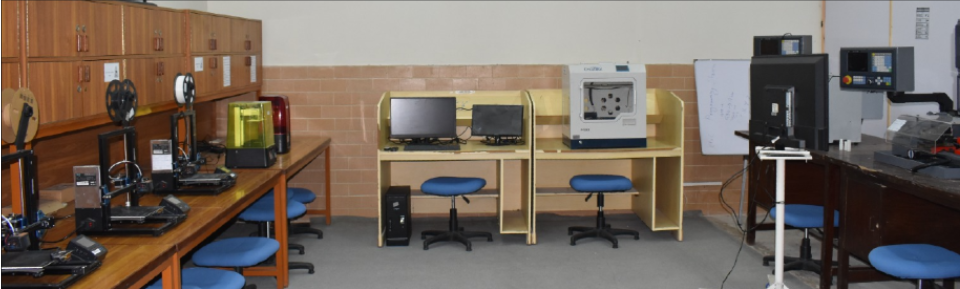
The 3D Printing Lab at the Faculty of Mechanical Engineering is a dedicated, state-of-the-art facility designed to support both undergraduate and graduate students in the exploration and advancement of additive manufacturing technologies. The lab primarily offers two types of 3D printing processes, Material Extrusion (FDM) with 11 printers and Vat Photopolymerization (DLP) with 2 printers. The 3D Printing Lab actively supports curriculum-based projects, senior year design projects, and research initiatives, fostering innovation, creativity, and practical skill development in the rapidly evolving field of additive manufacturing. Additionally, the lab is equipped with a 3D scanning system, which enables reverse engineering, quality inspection, and digital replication of existing physical components. This facility enhances the learning experience by integrating modern design verification and validation techniques.

Printed Electronics Laboratory


The Printed Electronics specializes in high-resolution EHD printing, featuring a multi-nozzle printhead capable of achieving less than 50 µm pattern widths for microstructures like sensor electrodes and interconnects. Complementing EHD, the lab extensively uses Micro-extrusion Direct Ink Writing (DIW) to create functional electronics structures and deposit thick, continuous material lines for robust applications. The facility’s research is dedicated to fabricating high-precision, low-cost sensors and electronic devices on flexible and stretchable substrates, including humidity, temperature, strain, flex, micro-heaters, and thermocouple sensors, with diverse applications in biomedical, environmental, and smart textile fields.


Robotics and Intelligent Systems Laboratories

Vibration, Dynamics and Control laboratory (VDC)


Vibration, Dynamics and Control System (VDC) lab has been designed to reinforce theory of Mechanical Vibration and Systems Dynamics and Control through hands-on approach. It has number of instrumented equipment on forced and unforced vibration, rotor-dynamics, health monitoring, multi-mode vibration test-rig, imbalance-response analysis, DC motor, aero-pendulum, inverted-pendulum, liquid-level system, ball and beam and 2-DoF aircraft. Most of the equipment are interfaced with PC running Simulink Real-Time software for real-time visualization. The Lab supports several research projects in the areas of unmanned air and underwater vehicle modelling and control, rotor-dynamics, active magnetic bearings as well as active vibration control are underway in the lab. The lab is well-equipped with PCs, NI DAQ cards, oscilloscopes, power supplies, micro-controllers, variety of sensors/accelerometers, instrumentations, impact hammer and soldering facilities.

Electrical Machine and Drives Laboratory


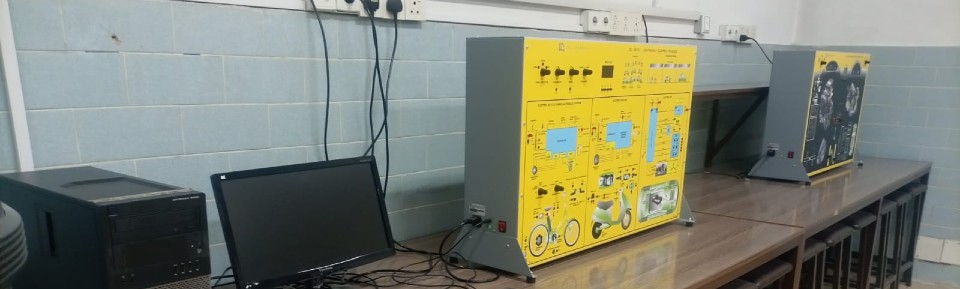
The Electric Vehicle (EV) Lab at GIKI provides hands-on experience to students about the working principles of electric vehicles. It includes different training systems like a Tesla Model S running system, battery and BMS trainer, magnetic levitation trainer, and trainers for lightweight and hybrid EVs. The E-Bus is also part of this lab, which has been designed and developed by undergraduate students at GIKI as a practical project. Students can also perform load analysis and battery thermal analysis in the lab to better understand EV performance and safety. In the future, the lab aims to design its own electric motors and compare them with the motors used in e-bikes in Pakistan.

Sub and Super Sonic Wind Tunnel Laboratory


The wind tunnel lab is designed to give students the opportunity to perform different experiments related to field of fluid dynamics and aerodynamics. The lab contains two subsonic wind tunnels. The main wind tunnel has the operational speed of 180 km/h and allows for pressure measurement variations over different aerodynamics shapes and determination of forces of drag and lift, including the different moments along pitch, yaw and roll plane. The whole process of the measurement is automated through a computer.

Robotics and Automation Lab


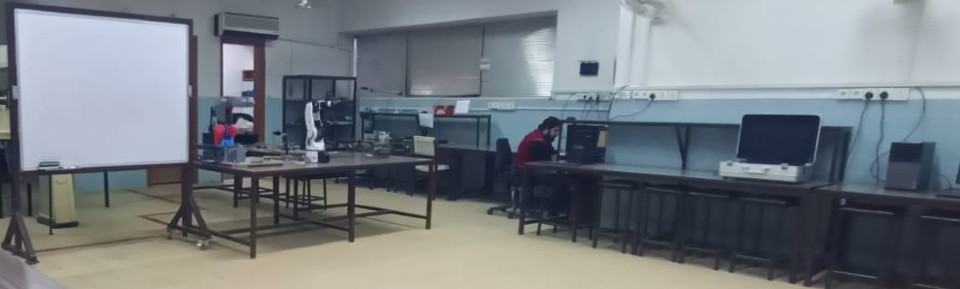
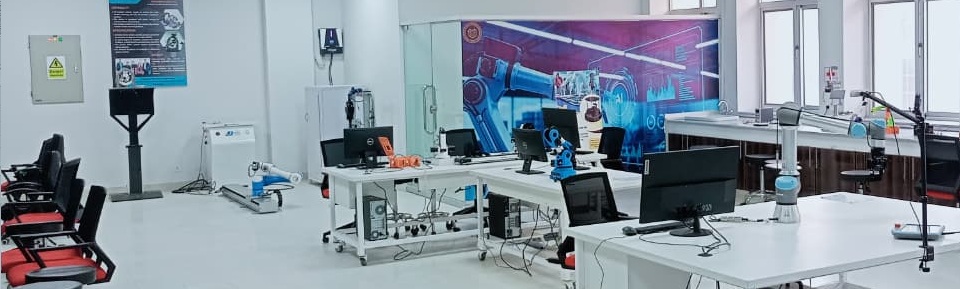
The state-of-the-art Robotics and Automation Lab at the Faculty of Mechanical Engineering (FME) is a center for advanced research and industrial collaboration. It features high-precision robots and grippers, including the Universal Robots UR5e and collaborative robots (cobots), reflecting the latest in robotic technology. The lab also includes mobile robots such as TurtleBots, equipped with advanced obstacle avoidance and SLAM capabilities. The key research areas of the lab include human-robot interaction, AI applications, and the integration of IoT technologies to develop digital twins for remote monitoring and control. The lab supports undergraduate and graduate courses by providing hands-on experience. It also facilitates internships, final year projects, and supervised research for MS and PhD students. lab supports undergraduate teaching for Robotics, Circuits & Electronic Devices and Electrical Machine & Drives courses.  This lab is well equipped with measuring instruments, oscilloscopes, DAQ cards, sensors as well as number of test rigs. This lab is also equipped with Puma robot and in-house developed linear stepper drive, servo loop and different robots.

Electrical Vehicle Technology Lab


The Electric Vehicle (EV) Lab at GIKI provides hands-on experience to students about the working principles of electric vehicles. It includes different training systems like a Tesla Model S running system, battery and BMS trainer, magnetic levitation trainer, and trainers for lightweight and hybrid EVs. The E-Bus is also part of this lab, which has been designed and developed by undergraduate students at GIKI as a practical project. Students can also perform load analysis and battery thermal analysis in the lab to better understand EV performance and safety. In the future, the lab aims to design its own electric motors and compare them with the motors used in e-bikes in Pakistan.

Computational Mechanics Laboratories

Computational Laboratory


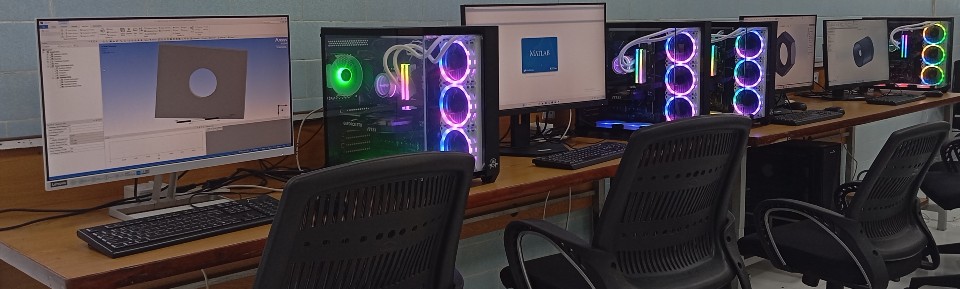
This laboratory consists of latest state-of-the-art 32 Intel Core-i9 (14th Gen) and 18 Intel Core-i7 (10th Gen) workstations. This laboratory provides training facility for modeling and simulation of products and processes including solid and computational fluid dynamics. Software library includes  ANSYS (Structural & Thermal Fluid modules), COMSOL, SolidWorks, CREO, 3D Doctor and MATLAB Campus Wide License and other analysis tools. These software’s allow development of 3-D models, mechanism design, linear and non-linear analysis of structural, thermal, fluid and dynamical problems. This facility has been used for conducting training workshops on computer integrated design products, development and manufacturing of engineering components for students, national and international participants.